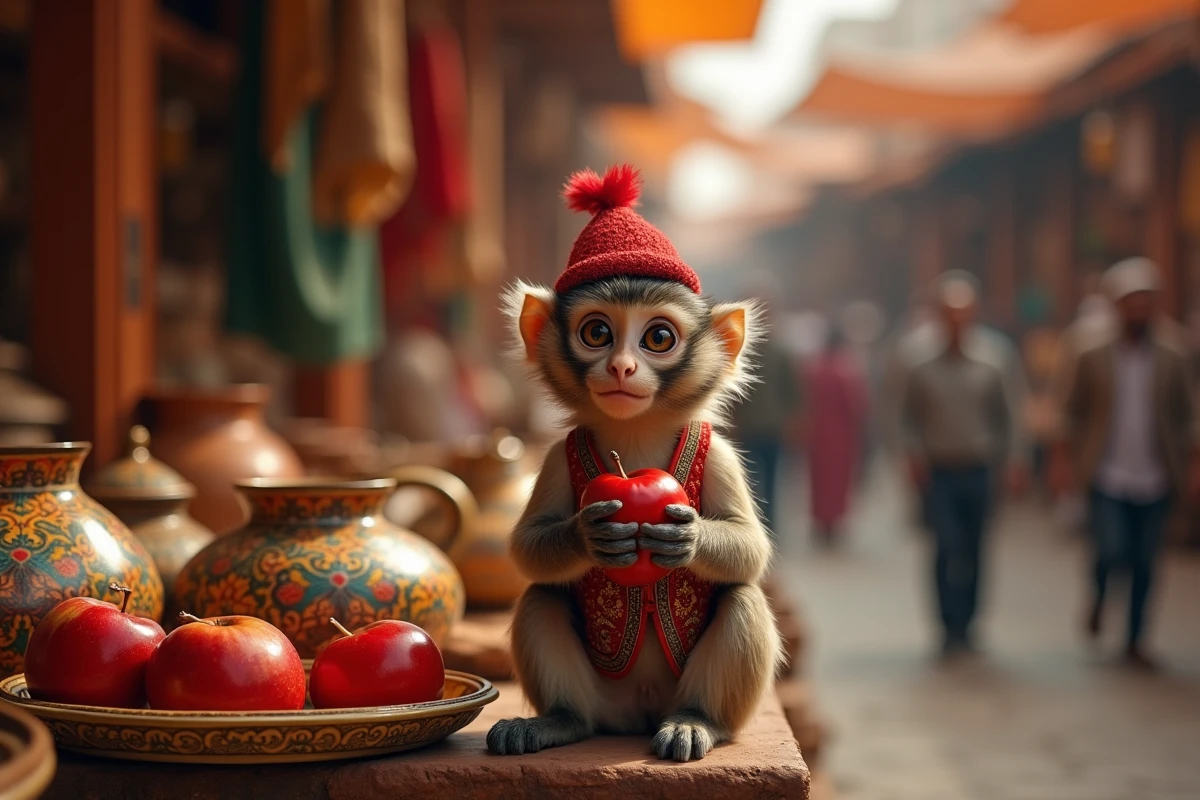
When revisiting Aladdin from 1992, Abu is the first character to steal something on screen. Even before the story sets its stakes, this capuchin monkey wearing a red fez snatches an apple from a market stall in Agrabah. This seemingly trivial act establishes the entire character arc for the rest of the film and beyond.
Abu and the Cave of Wonders: a scene that shapes the entire plot
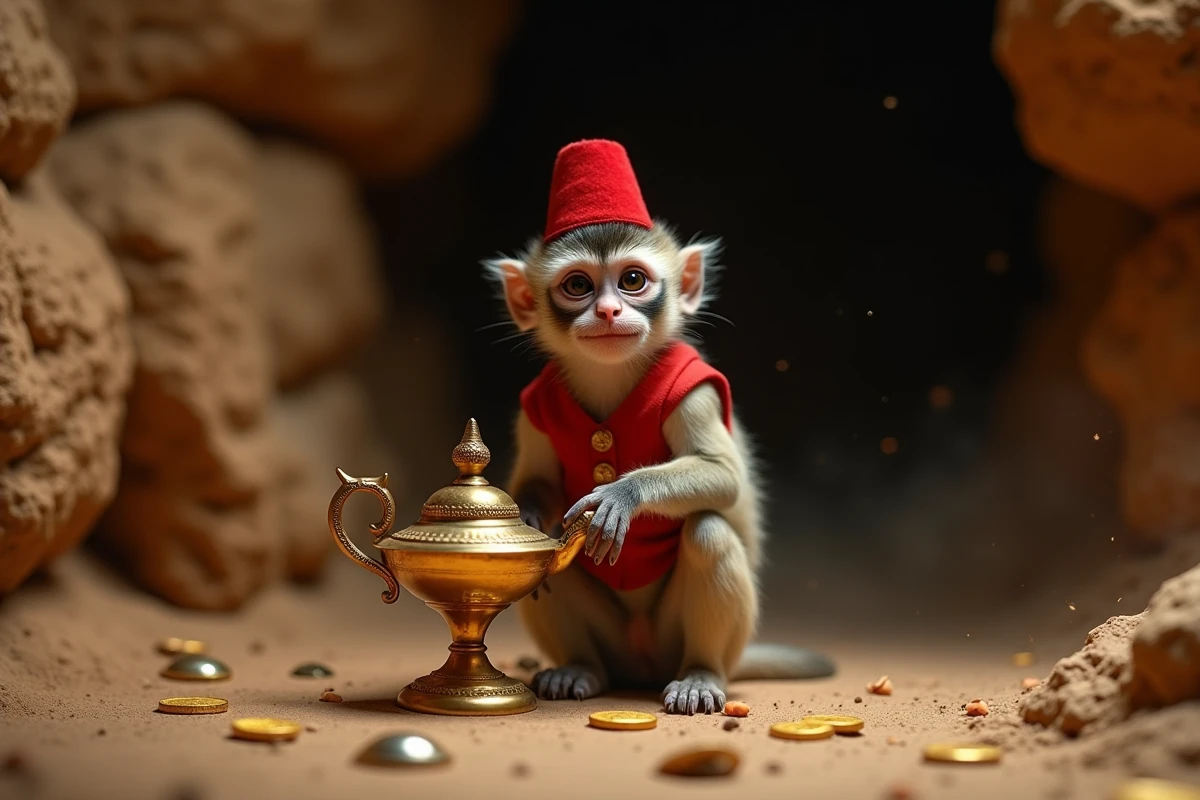
It is often forgotten that it is Abu, not Jafar or Aladdin, who triggers the catastrophe in the Cave of Wonders. The cave guardian’s instruction is clear: do not touch any treasure. Aladdin resists, but Abu succumbs to a giant ruby.
This writing choice is far from trivial. Abu causes the cave’s collapse through a compulsive act, consistent with his kleptomaniac nature established in the film’s opening minutes. The ruby he grabs is not just any object: its enormous size plays on the tension between the comedic (a small monkey facing a stone larger than himself) and the dramatic (the lava that floods the cave).
What makes the scene so effective is that it does not punish Abu definitively. He loses the ruby, but he is saved by the Carpet. The screenwriters thus preserve the viewer’s attachment to the character while making him bear the responsibility for a major narrative shift. One can read in detail the character of Abu in Aladdin Disney to gauge how much this sequence has impacted several generations of viewers.
Transformations of Abu in Aladdin: each form tells a story
Abu undergoes at least three physical transformations in the 1992 film. Each corresponds to a specific moment in the plot and serves a distinct dramatic purpose.
- The Genie transforms him into an elephant to legitimize Aladdin’s entrance to Agrabah as Prince Ali. Abu hates this form, and his grimaces convey a comedic discomfort that reminds us that Aladdin’s disguise is fragile.
- Jafar turns him into a mechanical toy (a cymbal monkey) during the climax. This transformation is the cruelest in the film: Abu loses his ability to act and speak, reducing the sidekick to an inanimate object.
- During the Cave sequence, the Carpet catches him just in time. Abu is not physically transformed, but his posture changes: he goes from thief to survivor, then to ally of the Carpet, a character with whom he had previously shared a comedic rivalry.
These metamorphoses are not decorative. They function as markers of power: whoever transforms Abu controls the plot at that moment. The Genie transforms Abu to help Aladdin, while Jafar transforms him to neutralize him. Abu’s form constantly indicates who dominates the situation.
Abu in Disney parks: a sidekick in decline
In theme parks, Abu has gradually lost visibility over the years. Visitor reports shared by fan sites like WDWMagic and DLRP Report show that the character has nearly disappeared from meet and greets and regular parades between 2019 and 2023.
His place has been taken by sidekicks deemed more commercially viable: Stitch, Olaf, Pascal. Abu now appears only on a few floats, fixed decorations, or during occasional seasonal events.
Abu in mobile games: a thief reduced to grinding
The same phenomenon is found in recent video games. In Disney Magic Kingdoms (Gameloft), Abu is used as a quest trigger for collection tasks. His animations reflect the “mischievous thief” angle, but his emotional and sacrificial dimension from the original film has been erased. Updates between 2020 and 2024 have optimized his skills for grind mechanics and temporary events.
This digital treatment reveals a shift: Abu has transitioned from a character with a complete dramatic arc (loyalty, temptation, sacrifice) to a functional asset in gameplay loops. Feedback on this point varies among player communities, but the general trend points to a dilution of the character outside of his original medium.
Voice acting and design of Abu: often underestimated animation work
Abu does not actually speak. He makes cries, grunts, and a few syllables that mimic human language without forming words. This choice, inherited from the Disney tradition of animal sidekicks, poses a considerable animation challenge: all emotion must be conveyed through body language, eyes, and the rhythm of gestures.
The animators of the 1992 film gave Abu facial expressions modeled after human reactions (furrowed brows, pouty lips, sidelong glances). This choice distinguishes him from a realistic animal and brings him closer to a silent actor. Abu performs physical comedy where the Genie performs verbal comedy, creating a balance between the two comedic registers of the film.
In the 2019 live-action remake, Abu becomes a CGI monkey. The result is divisive: the visual realism limits the exaggerated expressions of the animated version, and the character loses some of his comedic capital. The animated capuchin from 1992 remains, for the majority of viewers, the definitive version.
Abu has never had a film centered on him, nor a dedicated series. His status in the Disney ecosystem depends entirely on the vitality of the Aladdin franchise. As long as this franchise remains sidelined from the catalog, Abu recedes with it, despite an intact likability among fans of the original film.