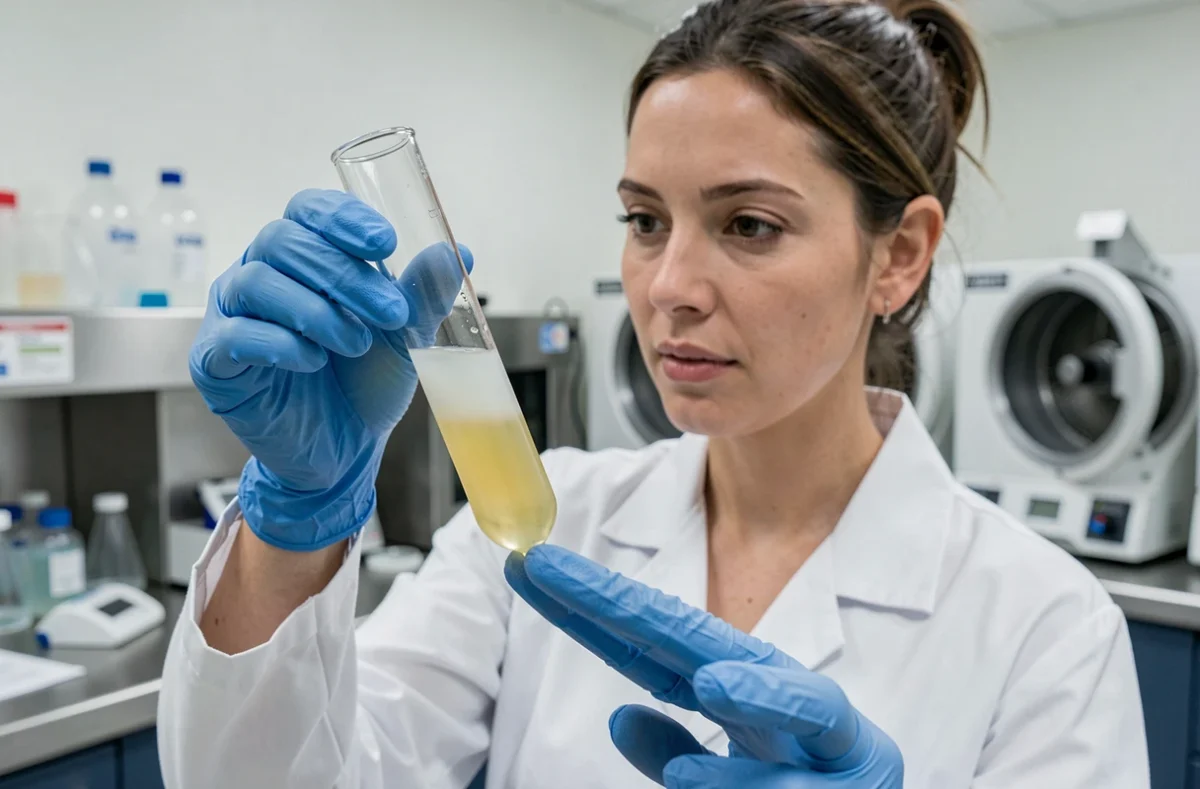
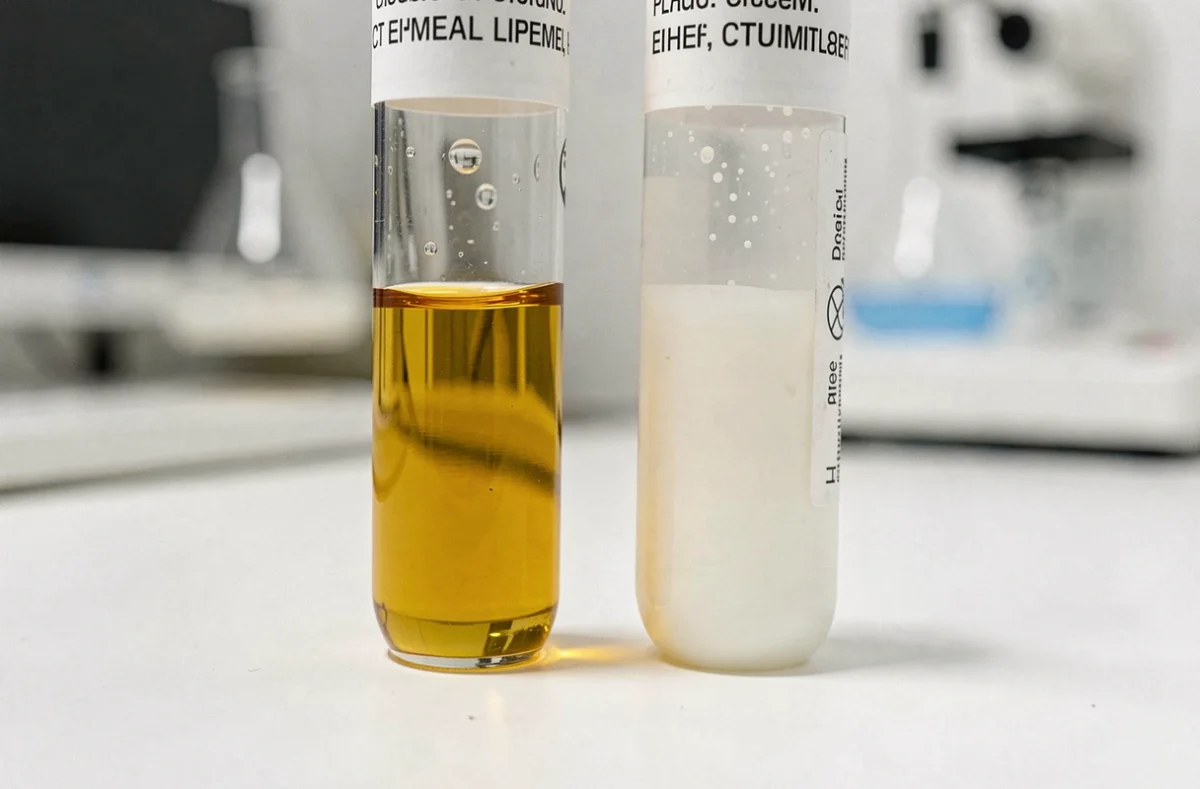
During a lipid profile, the first line of the report often mentions the appearance of the serum. This blood liquid, cleared of its cells and coagulation proteins, is normally clear and light yellow. After a meal rich in fats, it takes on a milky hue that the laboratory describes as opalescent. This visual change indicates the presence of lipid particles in suspension, and its significance varies depending on the context of the sample.
Size of lipoproteins and light scattering: the optical mechanism of lipemia
The opalescence of serum is not just a simple indicator of the amount of circulating fats. It primarily depends on the size of the lipoprotein particles in suspension. Chylomicrons, assembled by the small intestine from dietary fatty acids, are the largest of the lipoproteins. Their diameter is sufficient to scatter visible light, a physical phenomenon comparable to that which makes a glass of milk opaque.
This light scattering, called turbidity, is what the biologist observes after centrifugation of the tube. Serum loaded with VLDL (very low-density lipoproteins), which are smaller than chylomicrons, can also appear cloudy, but to a lesser extent. In practice, postprandial chylomicrons are primarily responsible for a milky serum in a patient who was not fasting.
When analyzing the appearance of slightly opalescent serum in a profile, it is essential to distinguish between what is a transient postprandial effect and what could signal a lipid metabolism anomaly.
| Type of particle | Main origin | Relative size | Impact on serum appearance |
|---|---|---|---|
| Chylomicrons | Dietary fats (intestine) | Very large | Marked opalescence, milky appearance if high concentration |
| VLDL | Hepatic synthesis | Large | Moderate cloudiness |
| LDL | Catabolism of VLDL | Medium | No visible opalescence |
| HDL | Liver and intestine | Small | No effect on turbidity |
Postprandial lipemia: factors that amplify or prolong the cloudiness
Postprandial lipemia peaks a few hours after a fatty meal. Its intensity and duration vary from person to person, and several parameters modulate the response.
- The amount of fats ingested plays a direct role: a meal very rich in saturated lipids produces a higher peak of chylomicrons than a moderately fatty meal.
- Alcohol consumption during the meal slows the clearance of triglycerides and may prolong the opalescent appearance of the serum beyond the usual window.
- Insulin sensitivity is involved: in insulin-resistant individuals, the clearance of chylomicrons is less efficient, extending the duration of postprandial lipemia.
- The baseline triglyceride level also matters: a patient with already elevated triglycerides while fasting will see the opalescence appear faster and last longer.
These variables explain why two people who shared the same meal can present very different serum appearances in the laboratory. Persistent opalescence several hours after the meal warrants clinical attention, as it may reveal a reduced lipid clearance capacity.
Opalescent serum and reliability of measurements: which analyses are distorted
The issue of lipemic serum goes beyond the aesthetics of the tube. Lipemia can interfere with several analytical methods in the laboratory. Light scattering disrupts spectrophotometric measurements, and the displacement of the aqueous phase by lipids alters the apparent concentration of certain analytes.
The assays most sensitive to this interference are those for LDL cholesterol (calculated or direct), bilirubin, and certain liver enzymes. In contrast, HDL cholesterol and total cholesterol are more resistant, depending on the technique used by the laboratory.
When faced with distinctly opalescent serum, the biologist may apply mathematical corrections, use a clarification technique (ultracentrifugation, dilution), or request a new fasting sample. A triglyceride result obtained from very lipemic serum must be interpreted with caution.
Non-fasting lipid profile: an evolving practice
The joint consensus of the European Atherosclerosis Society and the European Federation of Clinical Chemistry and Laboratory Medicine recommends a non-fasting lipid profile as the first approach. Fasting is mainly advised when non-fasting triglycerides are very high or when a specific clinical question justifies it.
This evolution in recommendations does not render the serum appearance unimportant. On the contrary, an opalescent serum from a non-fasting sample directs the physician towards a fasting control to confirm or rule out hypertriglyceridemia.

Hypertriglyceridemia or simple meal effect: distinguishing the two situations
An opalescent serum observed once, after a hearty meal, in a patient with no history, does not carry the same weight as an opalescence found in a fasting sample. In the latter case, the physician looks for hypertriglyceridemia, whether primary (genetic) or secondary (related to diabetes, hypothyroidism, certain medications, or alcohol).
A uniformly milky serum, beyond simple opalescence, suggests a very high concentration of triglycerides and an increased risk of acute pancreatitis. This clinical picture requires prompt management.
- An isolated cloudy appearance after a fatty meal, not reproduced while fasting, is indicative of physiological postprandial lipemia.
- Persistent opalescence while fasting points towards further testing (blood glucose, TSH, liver function tests).
- A distinctly milky serum while fasting, with very high triglycerides, requires immediate medical advice due to the risk of acute pancreatitis.
The appearance of the serum remains a simple yet useful visual indicator. When noted as opalescent in a profile, the first data to verify is adherence to fasting before the sample. If fasting was respected, the triglyceride result and the clinical context of the patient guide the next steps.